
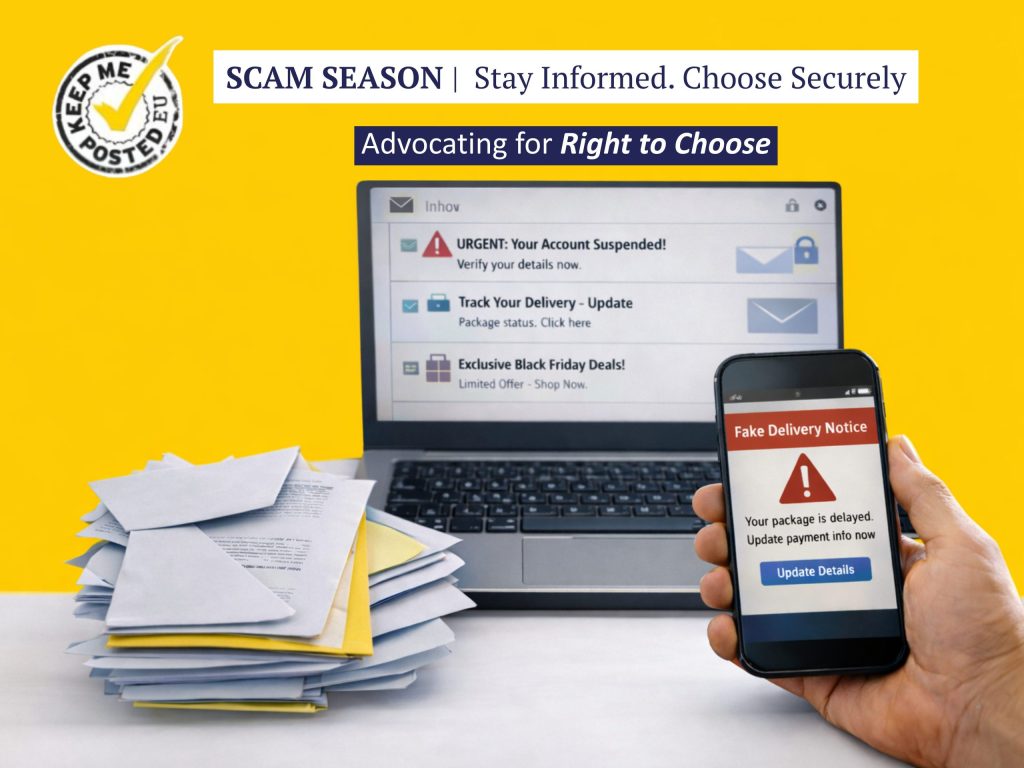
Every year, as Black Friday approaches, Europe enters one of the busiest online shopping periods of the year. Alongside genuine discounts and legitimate offers, the season reliably brings a surge in phishing emails, fake delivery notices, and fraudulent online shops. Cybersecurity reports show that scam activity consistently spikes in the weeks surrounding Black Friday, when shoppers are flooded with promotions, tracking updates, and payment confirmations that fraudsters can easily imitate. This pattern repeats annually, making late November and early December one of the highest-risk periods for digital deception.
In a landscape where digital risks escalate seasonally, preserving communication choice isn’t optional; it’s essential. For KMPEU, the mission to safeguard citizens’ access to secure, reliable communication channels becomes even more critical at this time of year. When services operate digitally only, people are far more likely to overlook important notifications, appointments, and official updates, especially when their inboxes are saturated with promotions and scam attempts. Maintaining alternative, trusted channels ensures that every citizen can stay informed and protected in the way that suits them best.
For many people, this season is not just about navigating sales; it’s about navigating uncertainty. Criminals take advantage of the heightened online activity by creating convincing messages that appear to come from trusted retailers, banks, or courier services. Security Magazine has reported that phishing attempts rose by more than 600% during the Black Friday period, illustrating how dramatically fraud intensifies. In a crowded digital environment, even confident internet users find themselves hesitating over whether an email is real, a link is safe, or a notification is trustworthy.
Many of these scams have also become more sophisticated, blending AI-driven impersonation techniques with seasonal urgency. As Forbes reported in its analysis of Black Friday fraud, scammers increasingly use convincing replicas of retail websites, automated chatbots, and realistic order confirmations to trick consumers into sharing payment details or clicking malicious links. These tactics work because they mimic the exact digital behaviour people expect during the shopping season, which makes the fraudulent messages harder to distinguish from real ones. With inboxes already crowded by legitimate promotions and shipping updates, even cautious shoppers can find themselves misled by these highly polished scam techniques.
These challenges affect some groups more than others. Older adults, individuals with limited digital skills, and those who already feel uneasy about digital transactions are disproportionately impacted. A study from the McKnight Brain Institute, University of Florida, highlights that older individuals are more likely to fall victim to phishing scams, not due to a lack of caution, but because today’s digital manipulation is so advanced that even minor errors can deceive almost anyone, and older adults are more vulnerable to these threats. Also, older adults have limited digital skills, and are at the same time uneasy about digital transactions. Seasonal spikes in scam activity heighten this vulnerability, making digital spaces feel even less predictable and less secure.
During this heightened risk period, the mission of Keep Me Posted EU to protect every citizen’s right to choose how they receive essential information becomes especially important. When important messages, official notices or appointment reminders are delivered exclusively online, people are more likely to overlook them amid the flood of seasonal promotions and scams. A fair and inclusive society requires that citizens can rely on alternative, secure and familiar channels for important communications. Upholding this right to choose ensures that no one is left behind or disadvantaged simply because of the way information is provided, while also encouraging citizens to remain vigilant about online scams, which are far more prevalent than fraud conducted through traditional mail.
This is why the #righttochoose how we receive important information is not just about preference, it is about safety and inclusion. KMPEU continues to advocate for this choice because it protects those who need it most. Maintaining access to paper communication ensures that people are not forced into digital-only systems at the very moment when online fraud is at its peak.